How to Prepare for a Layoff Before It Happens
The 10-day plan to protect your cash, your resume, and your options while you still have a paycheck.
Most layoff advice tells you what to do after you lose your job.
That’s too late.
The people who land fastest after a layoff are the ones who prepared while they were still employed. They did not need to see it coming. They treated preparation as a normal part of having a job.
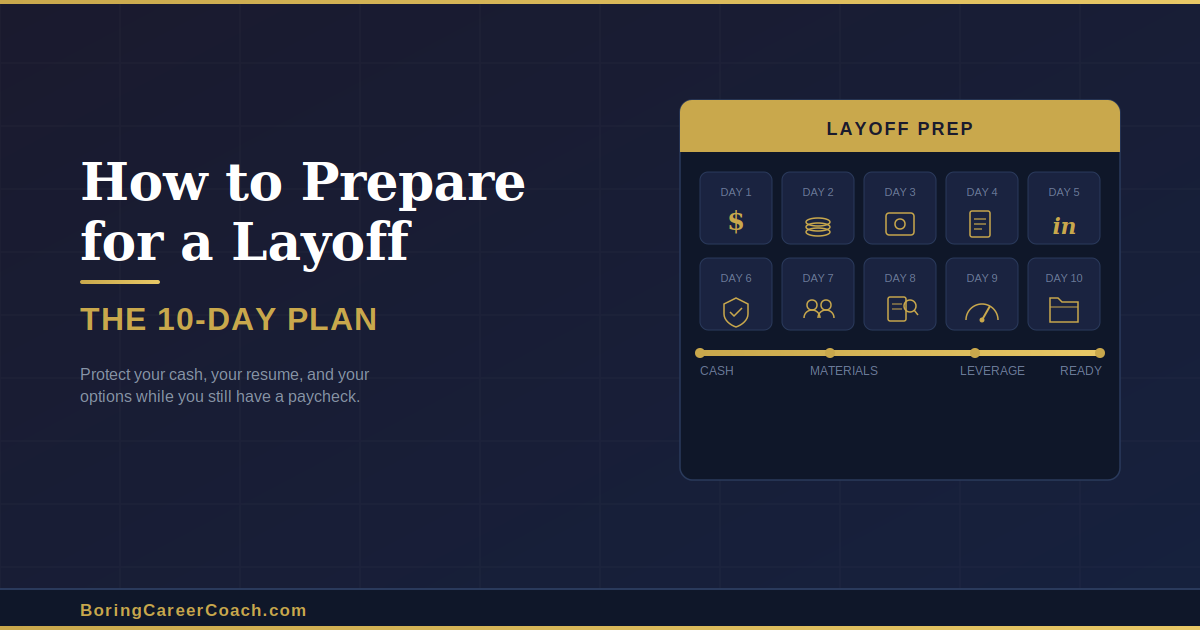
Here’s the system. Ten days. One task per day. No panic required.
First: Why Preparation Matters More Than Performance
Good performance does not protect you from layoffs.
Layoffs are budget decisions, not talent decisions. Your manager might fight for you. They might not win. Entire teams get cut because a product line gets killed or a re-org changes who reports to who.
The people who survive aren’t always the best performers. They’re the ones who are visible, portable, and financially stable enough to wait for the right next move.
If you’ve been coasting in a comfortable role and telling yourself “at least I’m safe,” read this: The Comfortable Job That Quietly Kills Your Career. Comfort and safety are not the same thing.
The 10-Day Layoff Prep Plan
You don’t need to do all of this at once. One task per day. By the end, you’re covered.
Day 1: Calculate your survival number
Open your bank statements. Add up what it costs you to exist for one month. Not your lifestyle. Your floor.
Rent or mortgage. Utilities. Insurance. Food. Minimum debt payments. That’s it.
Write that number down. That’s how many months your savings will cover if your income stops tomorrow.
If the answer makes you uncomfortable, that’s the point. You now know exactly how much runway you have.
Day 2: Build (or check) your emergency fund
If you don’t have three months of your survival number saved, start now. Automate a transfer from every paycheck. Even $200 per paycheck adds up.
If you already have three months, push it to six. The job market in 2026 is not the job market of 2021. Searches take longer. Offers take longer. You need breathing room so you don’t take the first bad offer out of panic.
Day 3: Screenshot your work
This is the one most people skip, and it costs them the most.
While you still have access, document every result you’ve delivered. Pull numbers from dashboards. Save before-and-after comparisons. Screenshot Slack threads where someone thanked you or a project shipped.
When you’re laid off, you lose access to all of it. And rebuilding your resume from memory produces weak, generic bullets.
If your resume already sounds robotic, that’s a separate problem: How to Make Resume Bullet Points Sound Human, Not AI Generated.
Day 4: Update your resume
Don’t wait until you need it. A resume written under pressure is a resume full of vague claims.
Use the screenshots from Day 3. Turn them into proof bullets: what you did, how you did it, what constraint you worked under, what changed because of it.
If your resume reads like a job description instead of evidence, run it through the resume enhancer to rebuild the weak bullets.
Day 5: Fix your LinkedIn
Your LinkedIn headline is the first thing a recruiter sees. If it says your current job title and company name, it tells them nothing about what you’re good at.
Change your headline to signal what you do and who you help. Not “Marketing Manager at xxCompanyxx.” Something like “B2B Marketing | Demand Gen | Pipeline from $2M to $8M.”
If you’re worried about your boss noticing, read the playbook: Your Boss Found Out You’re Job Searching. Here’s Your 72-Hour Plan.
For the full LinkedIn fix, this walks you through it step by step: Get Findable: How to Earn Recruiter Callbacks in 90 Days.
Days 1–5 protect your money and your materials.
Days 6–10 protect your leverage, your rights, and your options.
That’s the half most people never get to. They scramble after the layoff instead of setting up their safety net before it.
Day 6: Know your severance rights
Look up your company’s severance policy now, while you can still access the employee handbook. Most companies have one. Some don’t.
Things to know before your last day:
- How many weeks of severance per year of service?
- Is it negotiable?
- Does your PTO get paid out?
- How long does health insurance continue?
- Is there a COBRA subsidy or marketplace transition?
Knowing this in advance means you can negotiate from information, not emotion. The people who get better severance packages aren’t louder. They’re more informed.
Day 7: Start building relationships outside your company
Not “networking.” Building relationships.
Pick five people you respect in your industry. Send a message that isn’t “Can you help me find a job?” Send something useful. Share an article. Comment on their work. Ask a real question.
Do this while you’re still employed and the dynamic is peer-to-peer, not desperate-to-gatekeeper. The quality of your outreach drops the moment you need something. Start before you need anything.
If you want a system for outreach that doesn’t feel awkward, these scripts help: Cold Email to Hiring Managers: 5 Scripts That Get Replies.
Day 8: Check your non-compete and IP clauses
Read your employment agreement. Specifically:
- Do you have a non-compete? How broad is it?
- Who owns the work you’ve created?
- Are there any clawback provisions on bonuses or stock?
Most people don’t read this until they’re already out. By then, you can’t negotiate. If your non-compete is aggressive, you want to know now so you can plan around it, not discover it when you’re about to accept your next offer.
Day 9: Audit your operating number
Ask yourself honestly: if someone stripped away your title, your company’s name, and your team, would your work still hold up?
This is what I call your operating number. It measures your real level versus the level your role requires. If there’s a gap, that gap is what makes you replaceable.
A layoff doesn’t create the gap. It reveals it. The time to close it is while you’re still getting paid.
Here’s the full scorecard: Operating Number Scorecard: Are You A 2.8 In A 4+ Role?
Day 10: Build your “If It Happens Tomorrow” folder
Put everything in one place:
- Updated resume (PDF)
- LinkedIn URL
- Survival number and months of runway
- Severance policy notes
- Five warm contacts you can reach out to
- Screenshot folder of your best work
Store it outside your work computer. Google Drive, personal Dropbox, whatever. Just not on the laptop that IT will ask you to return.
Once this folder exists, you’re done preparing. You can stop thinking about layoffs and go back to doing good work. That’s the whole point. Preparation removes the anxiety. It doesn’t create it.
If You’ve Already Been Laid Off
If you’re reading this after the fact, the sequence changes. The prep window is closed, so now it’s about doing the right things in the right order.
The first 48 hours:
Don’t apply for jobs yet. Seriously.
- File for unemployment. Do it on day one. It takes time to process and you don’t want a gap.
- Review your severance offer. You do not have to sign it immediately. Most companies give you 21 days. Use them.
- Calculate your survival number (Day 1 above). Know exactly how long your money lasts.
- Tell your inner circle. Not social media. Not LinkedIn. Three to five people who can actually help.
The first two weeks:
- Document your work from memory while it’s fresh. Write down every project, result, and number you can remember. This gets harder with every day that passes.
- Update your resume using those notes.
- Start warm outreach (Day 7 above). Not cold applications. Warm conversations.
The biggest mistake people make after a layoff is jumping straight into mass job applications before their resume, story, and network are ready. That’s how you burn through your best leads with weak materials.
I wrote a longer breakdown of that sequencing mistake here: The Layoff Prep Mistake That Costs You Months.
The Rule That Makes All of This Work
Preparation is not pessimism.
The people who prepare aren’t expecting to get laid off. They’re making sure that if it happens, they get to choose their next move instead of scrambling for the first thing that comes along.
That’s the difference between landing somewhere good and landing somewhere fast.
If you want to know whether your current role is actually protecting you or quietly making you less competitive, start with the Operating Number Scorecard. That’s the honest answer.
Get the Next Script First
One email when a new post goes live. Scripts, templates, and the exact words to send. Free, and you can unsubscribe in one click.