Why Did You Leave Your Last Job? The 3 Hidden Tests
Three hidden tests behind one common interview question.
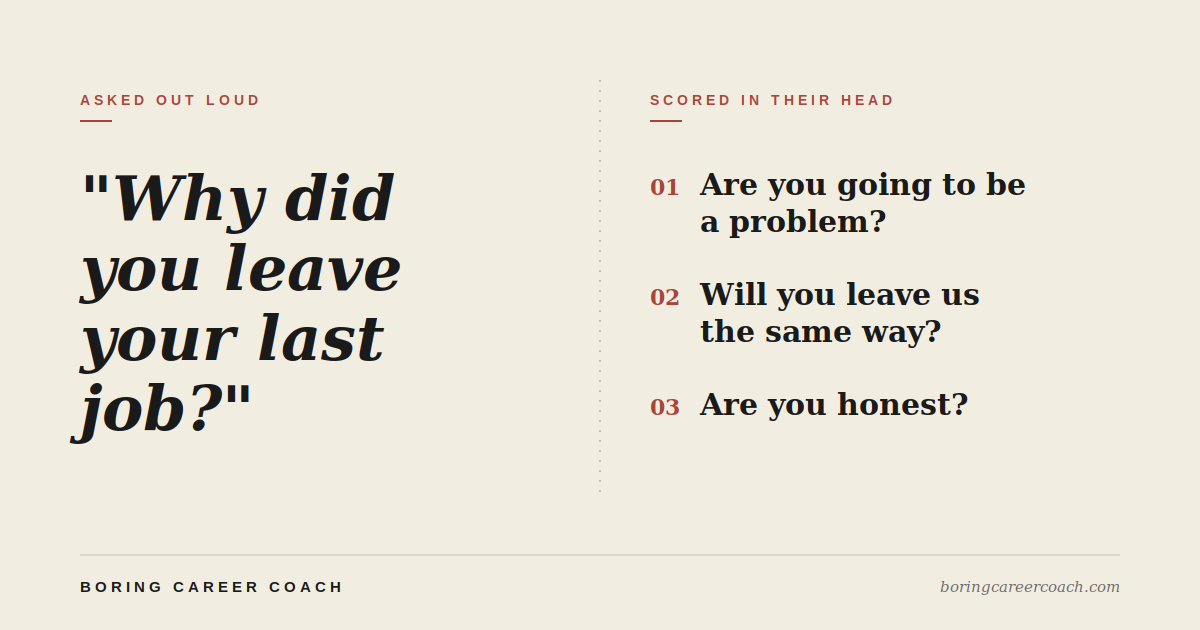
The interviewer asks one question out loud. They score a different one in their head.
What they actually want to know:
- Are you going to be a problem?
- Are you going to leave us the same way?
- Are you honest?
Every answer you give either passes all three or fails at least one. Most people fail one without knowing it.
Here is the pattern that passes.
Name what you wanted more of, not what you wanted less of
This is the whole trick.
Weak: “My old manager kept changing priorities every week, so I burned out.”
Strong: “I wanted clearer ownership of projects from start to finish. The role I was in moved priorities every week, and I learned I do my best work when I can see something through.”
Same situation. Completely different signal.
The weak version triggers all three alarms.
- Problem person? Maybe.
- Leaves the same way? Probably.
- Honest? Sort of, in a way that makes them harder to hire.
The strong version says: I know what I need to do good work, and I am looking for it here. Problem? No. Flight risk? Lower. Honest? Yes, and useful.
The pattern works on every version of the question
Laid off
“My role was eliminated last March in a restructure. I used the gap to finish an Excel certification I had been putting off, and I am ready to come back to analyst work full time.”
One sentence on what happened. One on what you did with the time. One on what you are ready for. Forward-looking. Honest. No spiral.
If you are still inside that gap, the order you do things after a layoff matters more than the speed.
Career change
“Ten years in nursing taught me how to read a room and stay calm when stakes are high. I have been moving toward project coordination because I want to use those skills in a different kind of team. I finished the PM course on Coursera last year and ran two community fundraisers.”
The pivot stops sounding like an escape. It starts sounding like a plan.
Left a job that was fine but not right
“I wanted to work somewhere closer to the customer. My last role was three layers removed from the people actually using the product, and I learned I want to be closer to that feedback loop.”
Same pattern every time. Name the thing you wanted more of. Tie it to what you learned about yourself. Stop.
The 45-second rule
Whatever your version, keep the answer under 45 seconds.
Long answers leak. The more you talk, the more the interviewer hears the parts you wish you had not said. Three sentences is usually enough. Four is the ceiling.
If you cannot say it in 45 seconds, you have not figured out what you actually want yet. That is the work to do before the interview, not during it.
What to do tonight
Write your three sentences. Read them out loud. Time yourself.
If it lands under 45 seconds and sounds like you, you are ready. If it sounds rehearsed, cut one sentence and try again.
The interview might be two weeks away. The answer should be ready tonight.
Related:
- If They Humiliate You In Hiring, Believe Them, the red flags inside the interview itself
- The Layoff Prep Mistake Nobody Talks About, what to do before you ever need to answer this question
Get the Next Script First
One email when a new post goes live. Scripts, templates, and the exact words to send. Free, and you can unsubscribe in one click.